Tuesday, June 14, 2011

Tim Pawlenty: Candidate Not As Advertised

Tim Pawlenty attacked Mitt Romney's health care plan characterizing it as calling it "ObamaneyCare" during an interview with Chris Wallace on Fox News Sunday on  the evening before the CNN Debate. However, when CNN debate moderator John King gave Tim Pawlenty to the opportunity call ObamaneyCare to Mitt Romney's face, he didn't have the guts to do it.

Here's the transcript of T-Paw's refusal to attack Mitt Romney: 
JOHN KING: "You don't want to address why you called Gov. Romney's Obamneycare?"

TIM PAWLENTY: "I just cited President Obama's own words that he looked to Massachusetts as a blueprint."

KING: "Why is it not Obamneycare standing here with the governor right now?"

PAWLENTY: "President Obama is the person I quoted ... Using the term 'Obamneycare' was a reflection of the president's comments."
In the eyes of many Americans, Tim Pawlenty revealed himself to be a weak, gutless and cowardly candidate. He can talk tough and come up with a clever zinger during a television interview but he lacked a spine to actually engage Romney in a debate when given the opportunity to do so. Alex Castellanos, a consultant to the Republican party explained to Politico how bad that response looked for Tim Pawlenty: 
“Debates are competitions – they are alpha dog battles,” explained longtime GOP ad man Alex Castellanos. “To win one, you have to create what I call an ‘MOS,’ a moment of strength. Tim Pawlenty had a chance to get in the ring tonight with the heavyweight champion and create such a moment. He refused to enter the ring. It was like LeBron refusing to take the big shot [Sunday] night.”
That is a mistake that will cost Tim Pawlenty. Its one of the biggest campaign debate flubs of all time. 
Yet, some commentators say that T-Paw's refusal to take on MItt Romney won't hurt him with the voters because many of them either were not watching the debate last night or didn't care to watch since the elections are so far away. However, its a moment that can be brought back and shown to the public later on in the campaign in the form of interviews and campaign commercials. It a mistake that that will haunt T-Paw for the rest of the campaign. 
Not only will that moment not play well with current and future voters, but T-Paw's unwillingness to take on Mitt Romney will have an impact on his campaign donations. There is a strong possibility that many of T-Paw's financial donors are considering taking their money somewhere else: 
Right now there is a fierce underground battle being waged over high dollar campaign donors. If you can’t raise money now, before the voters care, you will not have the resources you need to communicate with them when they do tune in. Organizing multiple states, waging straw polls, flying around raising money and running loads of TV and radio is all very expensive. Without constant fuel, a campaign locomotive grinds to a halt. For lesser known candidates like Tim Pawlenty this can create a cruel feedback loop; you need money to buy your way up in the polls, yet without good poll numbers it is very hard to raise money. Early debates are important because if you get good media reviews, you can aggressively peddle those to old and new donors to raise money.
Like weary troops or early investors in Broadway musicals, donors to candidates registering at 5% in the polls live on hope. Good early process reviews provide that hope. Donor phones come alive. “We’re staring to move up in… IA/NH/The North Barneyville straw poll!!” Sadly for Pawlenty, he did not get the clips he needed last night. Worse, his donor machine will get bad news instead of good. That’s a terror weapon for Huntsman and Romney. I’ll bet Mitt might be making a few calls to top Pawlenty donors today, thanking them for watching, expressing respect for their deep and touching loyalty to his good friend Tim and letting them he know he’d be happy to be their second choice… just in case things, well, don’t work out. We do need to unify, to beat Obama… Donors take those calls. Nearly every big donor has a plan B. Enthusiasm lags. Less pounding on the donor’s business contacts in Detroit or St. Paul for that extra check. The money wheels slow down and the bank account gets thin, just as the Iowa straw poll ramp-up costs start to mount.
As a result, this is a costly mistake that will have long lasting consequences for T-Paw. It may hurt him now or the pain may come much later in the campaign. As David Frum explains, this is the kind of mistake that cannot be undone now or in the future: 
Pawlenty’s failure is not the kind of stumble he can correct later. It goes to the core of the guy: offered the chance to confront Romney directly, he flinched. He did not look “nice.” He did not look like he was observing the 11th commandment. He looked uncertain and weak. He looked like a man fully aware that Romney would best him in a one-to-one discussion of healthcare policy…
After last night, Pawlenty’s fund-raising will sputter. He’s not exciting enough for ultra-base small donors. He does not look enough like a winner to mobilize big-dollar donors…
If [no one else gets in], I’d guess the future course of the race goes like this:
Bachmann wins Iowa. Romney wins New Hampshire. Absent Perry or Ryan, the field quickly empties out. The establishment rallies to Romney. The party follows just as it did in 1988, 1996 and 2000.
Perhaps the most important and potentially deadly consequence of Pawlenty's refusal to attack Mitt Romney was that it dealt a crushing blow to his image.
The man that Tim Pawlenty portrayed himself didn't match the T-Paw that voters saw at the debate. 
Rather than being the man who tells the hard truth like it is, he exposed himself as a timid, weak, uncertain candidate who is insecure about his own statements. Moreover, it made him look stupid since he couldn't even own up to his own clever zinger and claimed that he was merely recycling Obama's false claim that he used Mitt Romney's health care as a template for ObamaCare. It was a childlike excuse by blaming Obama for coming up with that zinger. 
The new image of Tim Pawlenty as a irresolute, hesitant and weak candidate who couldn't own up to his own words when the time for truth came is the kind of image that will stick in the mind of the American voter. Jason Miller, media consultant and former staffer on Rudy's failed election campaign, explained what probably went on in the voters mind when they saw that they didn't get candidate he advertised himself to be:
“Republican primary voters are looking for a presidential candidate who’s going to take the fight directly to President Obama,” Miller said. “If you’re not comfortable following through on a criticism of one of your primary opponents in person, why should voters think you’ll be able to man up and follow through on a criticism of the president when you face him in the general election?”
Americans desperately want a candidate who stands up for what they believe in and be willing to engage in a debate to promote his believe. He was trying to sell himself as a man who could fill that void that voters yearned for and the voters discovered that he wasn't the man he advertised himself to be. Steve Kornaki makes this same point over at Salon.com: 
But while he's tried hard (painfully hard), Pawlenty has yet to demonstrate that he's capable of filling this void, even though he's had ample opportunity to do so. His feeble performance at Monday night's debate in New Hampshire -- in which he awkwardly dodged a challenge to say to Romney's face what he'd been saying behind his back -- has been widely ridiculed, and rightly so. And while it's fair to note that this was just one debate (and a very early one at that) and that even successful candidates have bad debates, it should also be said that it wasn't anything new. Pawlenty has been leaving one audience after another underwhelmed for a long time now -- even though he tells every audience exactly what it wants to hear.
Tim Pawlenty portrayed himself as bold and strong candidate who can stand up and tell the unvarnished truth. He painted himself as a man who can say the hard things that people need to hear rather than the things that are pleasing to the voter's ear. Yet, that man was not present at the debates last night.
People are starting to see T-Paw in a new light and its an image that is going to hurt T-Paw's campaign image and his personal image as well. Its almost impossible to rebuild that kind of image once its been damaged.

Monday, June 13, 2011

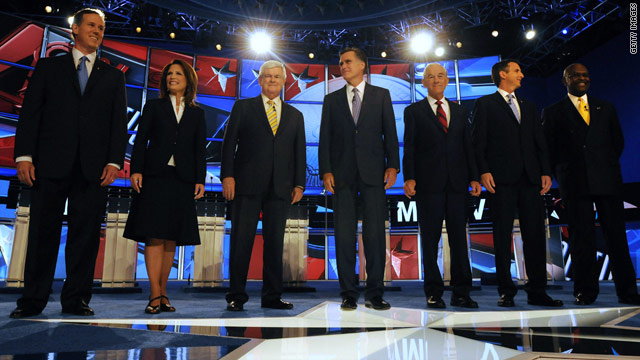
Mitt Romney Is The Winner Of CNN's New Hampshire Debate Tonight

Mitt Romney won the debates tonight hands down. Some of my readers might accuse me of being biased since I am enthusiastic supporter of him and have volunteered for his campaign. However, I'm not the only one who came to the conclusion that Romney's was the clear winner of the debate tonight. 
Ron Fournier of the National Journal points out that Mitt Romney was the winner because none of the other 2012 contenders were willing to take Mitt Romney on:   
The mitts were off Mitt. Romney received a pass from a strikingly timid field of rivals in Monday night's debate. Given chances to attack the early front-runner on health care reform, abortion and his history of flip-flopping, the rest of the GOP field pulled its punches. At one point, moderator John King asked if it was time to put the issue of Romney's authenticity to rest. That's like asking a lion whether it's time to stop chasing deer, and yet King's question went unanswered save for one barely audible, "Yes" from one of the candidates. There's a rule of thumb in political debates: When a front-runner leaves the stage unscathed, he's still the front-runner. And, thus, regardless of the sound and fury of the debate itself, he wins.
Michale Barone, writing for the Washington Post, explained why he thought Mitt Romney was the winner of tonight's debate:
Mitt Romney. In an early interchange on Tim Pawlenty’s disparagement of “Obamromneycare” Romney came out far ahead—and established a sense of command (a vital presidential quality) over Pawlenty and the other candidates. Romney came up with a good line—Obama never called me and asked my advice—and said that he would have said that Obamacare wouldn’t work. Pawlenty was on the defensive, saying that he was only responding to a question phrased in a particular way, and missed the chance to nail Romney for backing a mandate to buy health insurance—the feature of Obamacare which is now under attack in court by a majority of state governments. The subject never came up again, which is to Romney’s advantage. In addition, Romney gave good solid answers on several other questions, well tailored to the format demanding brief answers, on various issues. Notable among them was his defense of his opposition to the GM and Chrysler bailout, where he stood up for the rule of law and against turning over ownership shares to the United Auto Workers. On the debt ceiling, he launched a well justified attack on Barack Obama for not leading. I thought he misfired on one not very important issue, saying that eminent domain should not be used for private companies, when the question raised the issue whether it should be used for public utilities, which traditionally have had eminent domain-like powers to build electric transmission lines; but that doesn’t matter much in this context. Overall Romney showed a clear sense of command and directed well-aimed attacks at Barack Obama and his administration. He was well prepared for the format and did better than I thought.
Rich Lowery, writing for the National Review, said that this was Mitt' night and explained that Mitt Romney came out ahead because he stood out from the rest of the crowd:
Romney was on his game — smooth, relaxed, and unflappable. He did well in the debates in 2008, but benefited tonight from his increased stature in the context of the rest of field. In 2008, he was up against John McCain and Rudy Giuliani, strong personalities with real gravity, and Mike Huckabee, a fellow first-time candidate who is a natural performer. He was also helped by the unwillingness of anyone to take him on, most notably Tim Pawlenty on the “Obamneycare” charge. If Pawlenty wasn’t willing to back up that line in person, he shouldn’t have said it on TV Sunday.
Not only was Mitt Romney declared the winner by the media, but seasoned political warriors could agree that Romney was tonight's winner. National Journal talked to both Republican and Democratic insiders to get their professional opinion on who won that night and they all agreed that Mitt was the clear winner of that debate. 
As you can see, I'm not the only one who thought Mitt Romney won tonight. He won by setting himself apart from the rest of the other Republican candidates by giving clear and straightforward answers. Mitt Romney was also helped by the fact that none of the other candidates dared to attack Romney. I think many of the candidates will come to regret that choice, especially Tim Pawlenty who was given a few opportunities to attack Mitt but couldn't do it. That will haunt him for the rest of the campaign. 
However, it wasn't like Mitt Romney was given softball answers. There were plenty of questions ranging from gay marriage, Don't Ask, Don't Tell, Afghanistan and Iraq, illegal immigration that were definite minefields for each of these candidates. Mitt Romney navigated through them with very little difficulty. 
I would have to agree that Michelle Bachmann was the second place winner tonight. She started out by announcing her candidacy during the beginning of the show and managed to pass by the other candidates both in substance and style. I was really impressed with her and I think she will be the candidate Mitt Romney may have to worry about in the future. 
The biggest loser tonight was Tim Pawlenty. The fact that he came out swinging against Romney by attacking him on his health care program on a television program prior to the debates and refusing the opportunity to double down on his statement makes him look weak, gutless and cowardly. It was supposed to be a defining moment for him and people will no doubt look at him in a negative light. Aside from his refusal to attack Mitt Romney, Tim Pawlenty's overall performance both in substance and style was a major let down. He didn't rock the house like people hoped he would.
The other biggest loser was Newt Gingrich. He didn't look like he was having fun there. He had a scowl on his face the whole time. That doesn't win any points for him on style. As for substance, he didn't shine through despite his reputation as eloquent and intelligent speaker and debater. He lost a lot of points on substance too. 
I don't have any thing to say about Ron Paul. He was no different. He may have wowed his libertarian base but nobody else cared for what he said. 
I don't have much to say about Herman Cain or Rick Santorum either. Both performed better than Tim Pawlenty, Newt Gingrich and Ron Paul but lost to Mitt Romney and Michelle Bachmann. As a result, neither one doesn't come out as a loser or a winner in tonights debate. 
I'm a bit disappointed that Gary Johnson and Jon Hunstsman were not at tonight's debate. I think they would have helped spice up the night and made the debates more livelier. Moreover, it would have helped to give America a chance to see who these men are. Perhaps that's why supporters of Gary Johnson are quite pissed about the fact that he was not invited to tonight's debat because he couldn't get above the 2% average in CNN's poll. There were no expressions of unhappiness from Huntsman supporters (if there are any) outside the debate. 
What do you think about tonight's debate? Who do you think the winners and losers of the debate were?

Mitt Romney's New Ad: We're Not A Bump In The Road

Mitt Romney's new advertisement reveals just how out of touch Obama is when it comes to the issue of the economy. It is a powerful reminder Obama's policies and his careless remarks about his own lack of performance on the economic that generates the bad economic news has a real impact on the lives of everyday Americans. 
President Obama's statement is appalling for another reason. 
First, let us review how well the economy is doing right now. No matter what section of the economy you look at, it isn't doing well. The housing market is barely breathing since home prices in the United States have sunk to their lowest levels since 2002, falling 4.2 percent in the first quarter of 2011 and that further drops in home prices are expected in the future. There has been a steep slowdown in the manufacturing sector despite the fact that we are experiencing record highs in exports.
Most importantly, jobs aren't growing or declining but are simply stalling with only 38,000 Americans added to the workforce in May, the smallest increase since September. Unemployment currently stands at 9.1%. To look at things from a different perspective, just 19% of working Americans now report that their firms are hiring while 23% say their firms are laying workers off. Lets not forget that Obama's environmental policies will cause electricity prices to go higher and possibly cause the collapse of the coal industry which will lead more people out of jobs.
Since Obama has taken office as President, we have been doing $1 trillion dollar in deficit for the third straight year. We have a national debt of $14 trillion. As a result, Moody has threatened to cut our credit rating which is causing investors to be  worried about a future correction in the stock markets as a result of Obama bad economic policies. According to Senator Paul Ryan, if things stay the same as they are now, America won't survive past 2037.
As a result, Americans are increasingly growing pessimistic about the economy. 48% of Americans say that another Great Depression is likely to occur in the next year. 49% of Americans think that they will be paying higher interests rates next year. 79% of American adults are at least somewhat concerned about inflation while there are 52% of American adults who consider themselves as very concerned about inflation. Consider the latest Consumer Index Report that reports that an extremely high percentage of Americans think the economy is doing poorly: 
11% of consumers rate the U.S. economy as good or excellent, while 55% rate the economy as poor. Twenty-five percent (25%) say economic conditions are getting better, while 53% say they are getting worse.
As a result, 64% of voters say the country is heading down the wrong track while only 28% think America is heading in the right direction. Thus, its no surprise that unemployment was the number one concern with the economy following as the number two concern for Americans and it continues to be the primary concern today: 
Not surprisingly, with that much economic angst, the economy is the number one issue, the only one that more than half of the public says will be extremely important to their vote for president next year. Nearly all issues that at least four in ten say will be extremely important to their vote are domestic issues. Terrorism also makes that list, but Afghanistan is fairly low and Libya is tied for dead last out of the 15 issues tested. Abortion and gay marriage also rank very low, indicating that 2012 may be an election that is shaped more by bread-and-butter issues than social and moral concerns.
With Obama's liberal/progressive policies of promoting more federal government regulation and intervention, its no surprise that Americans don't want another four years of Obama in office. This is reflected in the fact that 47% of likely voters are worried more that the federal government will do too much rather than not enough in reacting to the nation's economic problems.
It is no wonder that Americans cannot take Obama seriously as an economic leader. Barak Obama has zero credibility when it comes to his promises of reducing unemployment and fixing the economy. Even his own actions demonstrate that this man isn't serious about the economy. Look this chart which takes a look at a wide range of economic indicators to show how disastrous Obama's has been for American economy in the first 25 months of his term. That is why even Obama's closest allies are starting to be upset with the fact that Obama hasn't done enough to create jobs in America.
Obama is scrambling to bring down unemployment so that he can keep his job as President. Currently, he's in North Carolina as part of a listening tour to promote his economic polices while at the same time find ways to bring down unemployment. But it is too late Obama to reverse his own horrible policies in order to fix the economy. 
Which brings me back to why President Obama's statement about the long line of bad economic news is merely a bump in the road is so appalling. What Obama is trying to do is make a mountain of bad economic news into a a molehill of bad economic news. By downplaying the seriousness of our financial situation, its not just the fact that Obama is ignoring or trivializing the impact his policies have had on the American people but its also a gargantuan distortion of how bad things are in America economically. 
As a result, its evidence that Americans and Obama have different perspectives about the current state of the economy. Obama has a distorted view of the economy whereas Americans have a correct view of it. J.D. Foster, a columnist writing for the National Review, drives this point home eloquently:
An economy is more than bricks and mortar, goods and services, labor and capital. It is also people acting in their own best interests guided by their expectations of what could be. Hope, confidence, expectations, whatever the label — it is a key factor often left out of the economics textbooks. But hope builds a bridge of positive actions from a weak recovery to a strong recovery. In purely economic terms, confidence arbitrages belief in a strong economy in the future and pulls some of that strength into the present, helping to make prosperity a self-fulfilling prophecy.
Presented with abundant evidence, the American people have rightly judged Obama economic policies failures, and they recognize he intends to continue those policies. Thus, they expect the economy to continue to muddle along, at best. Those are likely to be self-fulfilling expectations unless and until there is real change in Washington.

Sunday, June 12, 2011

Our Unhealthy Obsession With Flip Flopping

With the first real 2012 Presidential debate underway tomorrow, you will hear plenty of candidates accusing each other of flip flopping on various issues since many of the current 2012 candidates have flipped flopped in one way or another. 
For example, Tim Pawlenty has flip flopped on cap and trade, climate change, federally subsidized ethanol, Cuba, state’s rights, bailouts, endorsing universal health care coverage before he was against it, cap and trade, ObamaCare, and supporting the individual mandate before he opposed it. 
If Sarah Palin jumps in for 2012, you will hear people accusing her of flip flopping on climate change, cap and trade, unions, TARP, death panels, and gay rights.
Before we talk any further about flip flopping, lets get our definitions straight. A blogger wisely pointed out that "a flip is changing your position. A flip-flop is changing your position, and changing it back." As a result, when most people talk about flip flopping, they actually mean that a person was flipping on an position. 
But before you jump on me on whether or not these candidates actually flipped or flopped or how accurate these charges are, I want you to ponder and think about our unhealthy obsession with candidates who flip or flop on an issue. 
Stick with me for a minute as I explain why I think our country as an unnatural fixation on this subject.
"Flip flopping" is a label that people love to throw on politicians and it can do plenty of damage to a political campaign. Its been used so often that the term that flip flopping can mean anything. As a result, the label has has lost its meaning but none of its potency. Although the term is still potent, its only dangerous to politicians because people have inflated its value on a charge that is used so often and so cheaply.
There is danger is using a term too much. The problem goes beyond letting the word lose its precise meaning or its value. There is something much more deeply troubling. We're loosing our ability to think and only respond to words that so easily trigger our emotions rather than the neurons in our brain. We're letting the media, campaign mangers and political junkies do the thinking for us and allowing ourselves to conditioned by these very same people to respond negatively to a claim of flip flopping with out seriously considering the veracity or seriousness of the charge.
One of the dangerous side effects of our unhealthy obsession with nitpicking over the flips or flops of our elected officials is that makes our candidates rigid and unbending rather than being flexible and adapting to new facts and evidence. Kathleen Parker makes this point in her op-ed over at the Washington Post: 
Here we go all over again. Read my lips and bring ’em on. It’s the economy, stupid. Gotcha!
Which is to say, the stupid season is upon us. Same story, same characters, same plot twists. And yes, the same insanity. Plus ca change and all that.
To the familiar litany of cliches above, one hastens to add, “I was for it before I was against it,” the sine qua non of that quintessential political bugaboo — flip-floppery.
A politician may be able to survive cavorting with prostitutes, sexting with coeds and commingling with interns, but heaven forbid he should change his mind — the transgression that trumps all compassion.
Or thinking.
After all, thinking can lead to that most dangerous territory for a politician — doubt — and, inevitably, the implication that dare not be expressed: “I could be wrong.”
Eve Fairbanks, writing an article for Campaigns and Elections magazine, titled "In Defense of Flip Flopping" makes the same point in a different way: 
When political campaigns are so saturated with the flip-flopper attack, and when every flip-flop—big or small—is made out to be a Bad Thing, it makes candidates fear ever changing their minds.
Sure, candidates tack with the political winds, but there's no surprise in that. More important, politicians, like all people, sometimes change their minds when circumstances change or they gain more knowledge or just come into the wisdom of older age. Even the strongest backbones can bend.
Eve Fairbanks goes on to point out that there is a danger in clubbing every politician over the head for thier flip flops because it conditions society to think that all flips are equally bad and turns politicians into bad decisions makers:
Not all flip-flops are made equal, and not all flip-flops show the flip-flopper up as crooked. Some are panders; others are revelations. Some are big; some are small. We can usually tell the difference. But when the flip-flop attack becomes so common, we're led to think all flip-flops are the same. It oversimplifies the choices politicians have to make, and turns campaign season into a joke. 
Ms. Fairbanks goes also points out that there another harm of being so obsessed with every "flip flop" a politician makes is that its corrupting the political process by which we use to select our local, state and national leaders:
These accusations weren't all without merit. And there's reason to worry about flip-flopping candidates; after all, we want leaders with backbone who won't collapse under a little political pressure.
But when something works so well, we start wanting to try it all the time. And Kerry turned it into a dangerous example. Four years after seeing the way that attack destroyed the senator's presidential bid, we've begun to throw  the flip-flopper charge around so recklessly and arbitrarily that it's almost lost all meaning. 
Kathleen Parker addresses this same idea but points out another harm that comes with being upset with every "flip flop" a politician makes in that the voters themselves become unbending and inflexible in their views of politicians and the positions they take:
Those most averse to engaging in the sort of thought that could lead to self-doubt are, alas, those who constitute the political party base. These sometimes-wrong-never-in-doubt constituents are relentless in demanding ideological purity from their candidates and routinely banish those who don’t measure up. Thinking men and women need not apply.
These same folks also happen to constitute a minority of Americans, yet they control the debate. The rest of us are left to pick among the ideologically approved scraps. 
In short, combing every statement a politician makes for flip or flop doesn't help the vetting process of finding the best local and state leader because we have a knee jerk reaction to thinking that all flip flops are bad. It doesn't matter if a candidate has a genuine and change of honest change in opinion based on new facts or evidence or if its just a calculated move to win more votes, they're all the same to us now. 
We are becoming more rigid and unbending to ourselves and others who change their minds because we're holding everyone to an impossible and unrealistic standard in which no one can change their minds, especially politicians. Lets not forget that your boss recently flipped on which color the new product should be or that your son's teacher said that the homework assignment was due on Tuesday when she said it was due on Friday a week ago. 
Politicians get hammered for flip flopping on issues. They also get hammered on issues they actually take a firm and consistent position on. They'll get hounded if they even think about flipping. Damned if you do, damned if you don't.
The biggest problem is that we're slowly losing our ability to think and evaluate what's actually being said. Politicians, reporters, campaign managers and bloggers all know how to push the voters buttons and get the reaction they want from you. They all know that the public relies on them for information. In many cases, they know that the public lets the politicians, reporters, campaign managers and bloggers do the thinking for them. 
But it doesn't have to be this way. You can defy these people by being a smart, intelligent, informed and open minded voter. 
You should be thinking these questions to yourself as you hear one candidate accusing the other candidate of flip flopping: Is this a real flip or a real honest and sincere change of opinion? If its a change of opinon, why did they change their opinion? 
If its a flip flop, is it a major one or a minor one? Is is a significant or insignificant flip? How serious is this flip or flop? How accurate is the flip? Is the accuser actually distorting or twisting the candidate's words so that it looks like he's flipping on an issue?
As you watch the Republican debates tomorrow and pay attention to the rest of the 2012 election, don't accept every accusation of flip flopping at face value because they never are. 
If you take your job as a voter seriously, then we as a nation, can end our unhealthy obsession with flip flopping.and reducing the corrosive effect our fixation has on each other, politicians and the political process. 

Friday, June 10, 2011

Mitt Romney Getting Positive Reviews From Experienced Political Warriors

One of the most common criticism of Mitt Romney is that he's already had a chance at running for President and that people shouldn't give him a second chance in 2012. However, Mitt Romney is surprising a lot of people who have been in politics for a very long time with the way he's been running the campaign and the speeches he has been giving on the campaign trail. 
For example Peggy Noonan writes that she was startled by how impressive Mitt Romney has been on the campaign trial:
In other news, Mitt Romney had his first good week. It was startling. He stepped out from the blur. The other candidates now call him "the front runner." By most standards he was the front runner months ago, but nobody talked about him. He didn't live in the Republican imagination. It was "Will Mitch run?" and "You like Pawlenty?" Only seven minutes into the conversation would you get, "How will Romney do?" He was so '08, that disastrous year.
But this week he got three big boosts. He had a reasonable announcement speech followed by a lot of national interviews. Then the Washington Post poll: Mr. Romney leads President Obama. On top of that, the two most visible Republicans the past 10 days were Sarah Palin, on her magical mystery tour, and him. They got all the coverage, and for a moment it seemed like a two-person race. Meaning a lot of Republicans got to think, "Hmm, Palin or Romney—a trip to Crazytown or the man of sober mien." That did not hurt him. 
But Peggy Noonan should not have been surprised. After all, she did say during the last few days of the 2008 Republican primaries that Mitt Romney was the most conservative candidate in the race:
The Republican contest may well end on Tuesday, but I sense little relief and much unease. In terms of avowed programs, policies and approaches, Mitt Romney was the more conservative candidate, and his even-keeled air won many friends. He offered executive experience and business acumen. As for how he came across, here is Mike Deaver on Ronald Reagan: “This is a face that when the baby sees it, the baby smiles.”
Not everyone was intially a fan of Mitt Romney. Dick Morris was adamantly against Mitt Romney as recently as last April. However, even a hardened and seasoned political warrior like Dick Morris has been impressed with the former governor of Massachusetts: 
"I was at the Faith and Freedom Coalition last week.... and I heard them [the candidates] all speak. Romney was Reaganesque. Absolutely incredible."
What we're seeing is not only average Americans warming up to Mitt Romney but political warriors as well. As Mitt Romney heads into 2012, more and more Americans will be impressed with Mitt Romney. They will see him as the even-keeled, calm and focused leader our country needs. 

Mitt Romney Recieves Rock Star Attention While Flying Coach

Mitt Romney is like everyone else when it comes to flying airplanes. We all try to find the cheapest flights possible. Which means most of us fly coach rather than in business class or first class. Recently, Mitt Romney was spotted on an airplane flying coach. He was well received by flight staff members and other people flying on the plane:
Recently I flew from Philadelphia to Reagan National in D.C. on a U.S. Airways Embraer 170.  Sitting behind me was Mitt Romney.  Romney was in coach as this aircraft doesn’t have a first class section. 
I will never forget what happened next.  As word spread that the leading challenger to President Obama was on the flight, ground crew members and baggage handlers streamed up the stairs from the tarmac into the plane to get Romney’s autograph. They treated him like a rock star, one after another.  Anyone who has followed the airline’s labor history at the Philadelphia hub knows that the local Philadelphia union is among the most belligerent in the entire commercial aviation industry, nearly wrecking the airline with “sick outs” one holiday season.  If Romney gets the nomination, and the same reception in Philadelphia next November among these Reagan democrats, Obama is in trouble.
Obama isn't just in trouble with Reagan democrats. Even his biggest and staunchest supporters are unhappy with his poor performance on the economy:
In the wake of last week's disastrous jobs report, allies of the Obama administration are expressing extreme frustration at what they see as the White House's inaction on the issue. But there's little evidence that Team Obama is listening.
The economy added just 54,000 jobs in May, and long-term joblessness is at a record high. Federal Reserve chair Ben Bernanke admitted this week that the recovery has been "frustratingly slow."
That bleak news has prompted harsh criticism of the White House from many of the administration's friends, who view the focus on deficit reduction rather than job creation as badly misplaced, and who want more government stimulus to jolt the economy.
With Obama constantly ignoring the economy or taking last minute yet half hearted approaches to fixing the economy, its no wonder that people were happy to see Mitt Romney on the plane. They treated him like a rock star because they see him as a candidate who takes the economy seriously. 

Mitt Romney Busy In Michigan With New Staff Members and Speaking At A Major Michigan GOP Event

Mitt Romney's team is growing across the country. Recently, Mitt Romney added hired some great staff members to work on his campaign in Michigan: 
With Republican presidential candidate Mitt Romney headed to Michigan for events this week, he announced his in-state campaign staff on Tuesday.
Lori Wortz, a consultant who previously served as chief of staff to former state Senate Majority Leader Dick Posthumus, joins the campaign as senior advisor, and Rob Macomber, who served as director of candidate and party assistance for former state Republican Party chairman Saul Anuzis, takes over as state director.
Lauren Rakolta joins the campaign as finance director in the state. The daughter of John Rakolta -- the head of Detroit-based construction firm Walbridge Aldinger who served as a national chairman for the Romney campaign in 2008 -- Lauren Rakolta worked as a fundraiser for Romney’s 2008 run and his 2002 campaign for Massachusetts governor. Bryce Sandler, who was finance director for former U.S. Rep. Joe Knollenberg, comes on as deputy finance director in Michigan. 
In addition to adding excellent staff members to work on Mitt's campaign in Michigan, Mitt Romney has also pledged to attend the state GOP’s biannual Mackinac Island policy conference in September:
Romney, who was in Michigan on Thursday on a brief campaign tour, is the second presidential hopeful slated to address the conference. The first to confirm was former Georgia congressman Newt Gingrich. 
This isn't the first time Mitt Romney will be speaking at the MacKinac Island policy conference. He gave a speech there in 2007 prior to announcing his candidacy for the 2008 Presidential election.