Wednesday, May 11, 2011

Mike Larsen's Open Letter To Mike Huckabee

Ryan Larsen, the guy behind the pro Mitt Romney website, whyromney.com, has written an open letter to Mike Huckabee that is worth reading. And boy, he doesn't hold back in his attack on the former governor of Arkansas. 
Here is how Ryan Larsen's letter begins:   
Dear Governor Huckabee,

Everything I have heard Mitt Romney say about you the past three years has been positive. And there are a lot of positive things to say. Your down-home, folksy charm and wit add great spice to the Republican party. You have a calm, even temperament, and you obviously won over the people of Arkansas as their governor.

But for now, you hold a grudge. This may be partly due to your advisers only telling you what they think you want to hear. But the information they are giving you is not good at all. WhyRomney has refuted all your claims. I'd like to get to the bottom of your grudge and give you a chance to respond - to answer a few questions and correct anything I might be in error about. You can post your response anywhere on the internet, and I will re-post it in full, unedited, right below this letter.
You can finish reading entire letter HERE.
The letter is awesome because he destroys Mike Huckabee's record as governor. He also has fantastic video clips that are worth reminding us why this man doesn't deserve to win any primary election in 2012 or why he shouldn't be elected as the President of the United States.
Will Mike Huckabee respond to the open letter? Probably not. I would love it if he did. 

Newt Gingrich Releases Video Formally Announcing He's In For 2012

Newt Gingrich followed through with his promise to announce his candidacy on social media sites like Facebook, Twitter and Youtube. Watch the clip below as he makes the case for why he's the man to take on Obama in 2012.

Mitt Romney Gives More Details About His Healthcare Plan For America

Yesterday, Mitt Romney announced that he would be giving a major speech at the University of Michigan Cardiovascular Center in Ann Arbor in which he would reveal his plan to repeal and replace ObamaCare. The  Free and Strong America PAC, Mitt Romney's political action committee, has already released an outline of what he will present in Ann Arbor tomorrow. 
Today, Mitt Romney gives us sneak peak at what he will present tomorrow in an op-ed that was published at USA Today. In that article, he gives us five things that he will do to repeal and reform health care in America:
Step 1: Give states the responsibility, flexibility and resources to care for citizens who are poor, uninsured or chronically ill. This reform speaks to the central advantage of our federalist system — that different states will experiment with and settle on the solutions that suit their residents best. Some states might pass a plan like the one we did in Massachusetts, while others will choose an altogether different route. We can empower states to expand health care access to low-income Americans by block-granting funds for Medicaid and the uninsured. My reforms also offer the states resources to help the chronically ill — both to improve their access to care and to improve the functioning of insurance markets for others.
Step 2: Reform the tax code to promote the individual ownership of health insurance. The tax code offers open-ended subsidies for the purchase of insurance through employers. This subsidy is unfair — as it doesn't apply to insurance purchased on one's own. I propose to give individuals a choice between the current system and a tax deduction to buy insurance on their own. This simple change creates the best of both worlds. Absolutely nothing will change for those who like their current coverage. And individuals who don't get coverage through their employers will have portable, lower-cost options.
Step 3: Focus federal regulation of health care on making markets work. This means both correcting common failures in insurance markets as well as eliminating counterproductive federal rules. For example, individuals who are continuously covered for a specified period of time may not be denied access to insurance because of pre-existing conditions. And individuals should be allowed to purchase insurance across state lines, free from costly state benefit requirements. Finally, individuals and small businesses should be allowed to form purchasing pools to lower insurance costs and improve choice.
Step 4: Reform medical liability. We should cap non-economic damages in medical malpractice litigation. The federal government would also provide innovation grants to states for reforms, such as alternative dispute resolution or health care courts.
Step 5: Make health care more like a consumer market and less like a government program. This can be done by strengthening health savings accounts that help consumers save for health expenses and choose cost-effective insurance. For example, we should eliminate the minimum deductible requirement for HSAs. The market reforms I am proposing will drive down costs, better inform consumers and improve the quality of health care in our nation.
In the op-ed, Mitt Romney reiterates his pledge to issue an executive order granting waivers for all 50 states to be freed from ObamaCare while Congress works to repeal Obama's health care bill. Many people think that Mitt Romney cannot issue that executive order but I think he can.
As I predicted, you would not see the individual mandate anywhere in his new health care plan for America. That's because it was never a central part of his plan. It was mere side show that was designed to eliminate the public dependency on government health care,  prevent those who fraudulently use the system for their own selfish ends and shift the responsibility of health care away from the government to the individual. 
When Mitt Romney reveals the full details of his plan tomorrow, you'll see it will be radically different from his health care plan in Massachusetts. 
Moreover, the new health care plan will be a great counter punch to Obama's health care plan because it will be based on conservative principles of free markets, personal responsibility and accountability as well as promote federalism in which each state is free to manage and tackle health care in their own state.  
Tomorrow, everyone will be eager to hear the full details of Mitt Romney's conservative approach to fixing health care. Check back here for a full analysis of the Mitt's speech. 

Tuesday, May 10, 2011

Mitt Romney To Unveil His New Health Care Plan For The Nation On Thursday

Mitt Romney will unveil his strategy to repeal and replace ObamaCare at the University of Michigan Cardiovascular Center in Ann Arbor. Mitt Romney's PAC, Free and Strong America, has already released an outline of what he will present on Thursday:
· Restore to the states the responsibility and resources to care for their poor, uninsured, and chronically ill.

· Give a tax deduction to those who buy their own health insurance, just like those who buy it through their employers.

· Streamline the federal regulation of healthcare.

· Reduce the influence of lawsuits on medical practice and costs.

· Make healthcare more like a consumer market and less like a government program.
Mark Halperin thinks this is a great move for Mitt Romney:
This is smart. Romney won't back off his past statements on his Massachusetts health care law Thursday. The plan he is releasing is an updated version of the one he ran on in 2008.
Romney's rivals believe health care makes him unnominatable. Romney has failed so far in convincing the media and others that he can explain his record on this issue. By putting out a detailed plan well before any of his opponents, Romney has his best chance to move the conversation from the past to the future. Hillary Clinton tried to do the same thing on Iraq in 2008 and almost succeeded; and/but right now Romney doesn't have anyone standing in his way for the nomination who is as politically formidable as Barack Obama was four years ago.
In 2006,  Mitt Romney gave a 25 minute speech followed by a 15 minute Question and Answer session after the presentation of his plan at the Heritage Foundation. You can view the slide show of his presentation here. I expect this presentation to be similar to the one he will give in Michigan on Thursday.
I  think this is a smart move for Mitt Romney. He has been opposed to a national health care plan since 1993 when President Clinton appointed his wife to implement HiliaryCare. He was opposed to opposed HillaryCare 2.0 in 2007. He was still opposed to a universal health care plan while it was being considered by Congress under President Obama. That bill became known as ObamaCare. Sometime around May of 2009, He offered 6 points of advice in an op-ed to President Obama about how to fix our nation's health care problem.  Two months later in July, he continued his attack on ObamaCare by writing an Op-Ed for the USA Today asking why the President was rushing to pass the bill.  Once the bill was passed and signed by the President,  Romney called for it’s repeal.
This is Mitt Romney's chance to explain what parts of his health care plan would he like to see implemented at the national level. He is often criticized by some conservatives for a statement he made at a speech in Baltimore back in February 2, 2007 when he said his plan would be a model for a nation:
"I'm proud of what we've done," he said. "If Massachusetts succeeds in implementing it, then that will be a model for the nation."
Mitt Romney reiterated that statement a few years later in 2009 during an interview with CNN: 
"I think there are a number of features in the Massachusetts plan that could inform Washington on ways to improve health care for all Americans," Romney told CNN. "The fact that we were able to get people insured without a government option is a model I think they can learn from."
Many conservatives and democrats assumed that Mitt Romney wanted to introduce the idea of individual mandates at the national level. However, that is not true. In an interview with Chris Matthews back in 2006, Mitt Romney explained what the key feature of his plan was:
The key feature here is we’re letting people get their own private health insurance, not a government plan, not a government insurance plan, not a government takeover in any way, shape or form, no new taxes being applied. And as a result of doing that, we’re getting everybody insured.  It’s with portable insurance purchased from the private companies.  
During that interview, Mitt Romney explains what the key feature of his health plan that he would like to see implemented at the national level.
MATTHEWS:  Let me ask you about something I’m very impressed with, and everybody else will be, I think.  And that’s what you have been able to accomplish up there with health care.  Everybody wants health care for people who are working and playing by the rules and trying to raise families and not having enough money to pay for expensive health care.  Will the Massachusetts effort that you’ve just signed now, will it work for the country? 
ROMNEY:  Well, it will work for Massachusetts, and that’s of course the thing that I had to focus on.  There are certain aspects of it that I think would work across the country, perhaps better in some states than others.  Of course the great thing about federalism is you let a state try it and see how it works before you spread it out.
But there’s some key features and I think this is one of them, which is that we are already spending billions of dollars in our country and in my state, about a billion dollars, giving free care to people who don’t have insurance.  And the question was, if we took that money and helped them buy insurance, could we have everybody insured and the answer is yes. 
We don’t need new money.  We don’t need new taxes.  We could use the money we’re currently spending and get people better health care without having the burden and the cost of the uninsured being borne by everybody else.  
Actually, there are two key features in Mitt Romney's health care plan. Helping poor people get health insurance is just one part of the key feature of his plan as the former governor of Massachusetts explained above. However, the other essential feature of his plan was helping those who work as freelancers or independent contractors afford health insurance: 
MATTHEWS:  So people below the poverty line are covered by Medicaid. 
People who have good jobs and good employment contracts have health care.  The people in the middle, the people who are freelance, in the business I’m in right now, television, freelance people don’t get health insurance.  People that are above the poverty line don’t get the advantage of Medicaid unless they impoverish themselves. 
Is there enough money in saving from emergency rooms and other costs to cover the cost of that middle of the road person who is somewhere between the poverty level and well off? 
ROMNEY:  Well, that’s what we found.  We studied at some length the people who didn’t have insurance, and we found, first of all, that about 40 percent of those that don’t have insurance had plenty of income to buy their own private policy if it were reasonably priced.  So we stripped out some mandates.  We allowed co-pays and deductibles that are larger.  And those people can buy insurance. 
As Mitt Romney explains it, the key feature of his plan was designed to help two groups of people who traditionally cannot get health care on their own: (1) those who are under the poverty line and (2) those who work as freelancers or independent contractors. 
When it comes to empowering the people who are below the poverty line to be able to afford private health insurance, Mitt Romney essentially created a medical voucher system for them. All he did was shift the money that the state and federal government get to cover the cost associated with hospital visits by the uninsured into  a system whereby people could use that money to buy health insurance. 
As for the freelancers and independent contractors, Mitt Romney found a solution that would encourage  health insurance companies to offer reasonably priced health insurance by allowing them to offer larger co-pays and deductibles. 
As you can see, the key feature of RomneyCare isn't the individual mandate. That is not what Mitt Romney wanted to see implemented at the national level. Its clear from Mitt Romney's interview with Chris Matthews that what Mitt Romney wanted to see implemented nationally was medical vouchers for those who are below the poverty line and making health care affordable for those Americans who work as independent contractors by allowing private health insurance companies to offer co-pays and deductibles.  
Many people, both on the left and the right, have fallen into the mistaken notion that the individual mandate was the essential ingredient in his health care plan and erroneously assumed that is the part that Mitt Romney wanted to see at the national level. It wasn't. It never was. 
Even President Obama and the democrats in Congress who actually wrote ObamaCare made the mistake of making the individual mandate the key feature of ObamaCare. Had they contacted Mitt Romney and asked him what essential part of his plan was, they would have found out that the individual mandate was never intended to be implemented at the national level. 
After 20 minute speech at the Republican Jewish Coalition in Las Vegas, Mitt Romney explained during the question and answer session that Obama never called him to ask for his advice about how to deal with health care at the national level:
“He does me the great favor of saying that I was the inspiration of his plan. If that’s the case, why didn’t you call me?” Mr. Romney said. “Why didn’t you ask what was wrong? Why didn’t you ask if this was an experiment, what worked and what didn’t?”
To applause, he added: “I would have told him, ‘What you’re doing, Mr. President, is going to bankrupt us.”
This isn't the first time Mitt Romney has pointed out that President Obama never asked for his advice about what worked and what didn't work with Romney's health care plan. In an April 19th Newsweek Magazine article, "Romney On RomneyCare",  Mitt Romney told the reporter this:  
"He never gave me a call. Neither he nor any of his colleagues [gave me] a call to ask what worked and did not work, and how would they improve upon it and so forth. If what was done at the state level, they applied at the federal level, they made a mistake. It was not designed for the nation." 
The individual mandate in Mitt Romney's plan was designed to (1) permanently end people's dependence on the government for their health care needs and (2) to get people, who can afford health care, to stop using the government as an alternative way of getting health care without having to pay for it.
Conservatives have always promoted the idea that people should always be accountable and responsible for themselves. People cannot be accountable and responsible for themselves if they look to the government to provide for their basic needs. Moreover, people cannot be accountable and responsible for themselves if they are looking for ways to get others to pay for their basic needs instead of finding ways to meet their own needs through their own hard work and effort.
Mitt Romney realized that there will always be people who want a "free ride" despite the fact that they have been given ample opportunity to get and afford the things that they need and want.  They illegitimately use the government for services and benefits regardless if there are tax breaks, vouchers, larger co-pays and deductibles and other tools that would allow them get private health insurance. 
Not all free riders are people looking to cut corners and to evade responsibility. There are those who simply cannot afford to purchase health care and sincerely as well as legitimately use the government to satisfy their health care needs. They're not looking to cut corners and to avoid personal responsibility. The are trying to be good decent people but cannot afford to purchase health care with their honest wages.
Regardless if people are "free riders" for legitimate or illegitimate purposes, its clear that the government created the free rider problem in the first place. Our politicians created people's dependency on government by offering free health care to those who couldn't afford it. Our politicians invited people to take advantage of the government even though they could afford to purchase their health care insurance and encouraged people not to take personal responsibility for themselves by offering free health care to them. 
The individual mandate is just one conservative solution to the free rider problem. It discourages those who illegitimately use government for getting their health care needs and empowers those who cannot afford private health insurance by providing medical vouchers so that they can afford it.
Mitt Romney's health care plan is also libertarian solution to the free rider problem. In a 2006 op-ed in the Wall Street Journal, he wrote: 
"Some of my libertarian friends balk at what looks like an individual mandate. But remember, someone has to pay for the health care that must, by law, be provided: Either the individual pays or the taxpayers pay. A free ride on government is not libertarian."
During the question and answer question at the Republican Jewish Coalition, Mitt Romney explained that his health care plan was an experiment to resolve the free rider problem: 
"If somebody in your state who doesn't have insurance has a terrible automobile accident … we don't let them die in the street," Romney said. "Guess who pays for it? You. The government."
"We said, you know what, this free rider problem is a real concern," he added. "That concept led us to coming up with an experiment."
Despite the fact the individual mandate is a conservative/libertarian solution to the free rider problem, many people think that the individual mandate is a government solution to a very serious problem. The only "government" thing about it is that it's a government mandate (this is the government part of it) that everyone obtain private insurance for use with private sector healthcare providers, e.g. doctors.
In conclusion, I am excited to hear Mitt Romney's presentation at the University of Michigan Cardiovascular Center. Mitt Romney has already given his general plan on how to get rid of ObamaCare but now he will lay out the specifics of his plan to repeal ObamaCare.
As far as his plan for replacing ObamaCare, I think Mitt Romney will focus on the two key features of his plan that he has always wanted to see at the national level. I predict that he will he will propose ways to empower people below the poverty line to have the ability to private insurance for use with private sector health care providers and outline ways for contractors, independent workers, and free lancers to afford health care.
Although the news indicates that Mitt Romney will reveal his health care plan based on an updated version of the one he ran on in 2008, I predict that the individual mandate will not be part of his plan to replace President Obama's health care plan with his own new health care plan for America. The individual mandate was not an essential feature of his health care plan in Massachusetts and I'm fairly confident that it will not be a key feature in his new plan for America.

Sunday, May 8, 2011

Newt Gingrich Is In For 2012

Last week, Newt Gingrich said he would make his decision on whether or not he would be running in 2012. He's made his decision and has formed an exploratory committee which is a required step in the process of becoming a candidate to run in a presidential election. He will announce his candidacy via Twitter and Facebook on Wednesday.
Newt Gingrich has quickly been assembling his team together: 
Former House Speaker Newt Gingrich will tap Rob Johnson to manage his GOP presidential bid.
Rick Tyler, Gingrich’s long time communications aide who will be campaign press secretary, said Johnson will get the top campaign post. Johnson became an adviser to Gingrich about six weeks ago.
The 36-year-old Johnson is well known in Texas GOP circles, but running Gingrich’s presidential drive is likely to be considerably more challenging than his previous experience. Johnson ran Texas Gov. Rick Perry’s successful re-election campaign last year. Earlier he served as campaign manager for Lt. Gov. David Dewhurst in 2002 and then became his chief of staff.
Tyler said Johnson’s “special strength is how to harness the Internet for modern campaigns. He did that in Texas and he will have the same capability for Gingrich nationally.”
Gingrich will formally enter the race for the Republican presidential nomination by May 13.
Newt Gingrich will be a formidable candidate in 2012. He has the name reconition. People remember him fondly for the Republican surge in the 1990s in which he ended 40 years of democratic control of the House. People also know him well from the various articles, books, lectures, stories and media appearances that he makes. He is admired for his creativity and intelligence in coming up with innovative ways to resolve issues that face America. He's also well known for managing various different advocacy and for-profit groups which will help him indirectly in 2012.  
Running in 2012 won't be easy for Newt. He's a polarizing and controversial figure both on the right and on the left. He's undoubtedly controversial among many conservatives. For example, his recent religious conversion from being a Baptist to a Catholic has people praising or criticizing him for his new found faith. However, some people think his conversion to Catholicism will help him in 2012:
Some observers believe Gingrich’s newfound Catholicism, which came as he ought public forgiveness for his marital infidelity, could help his appeal among Christian voters by demonstrating that he has been “spiritually reborn.”
"Newt's conversion could affect his candidacy in an indirect way by helping him explain some of his decisions," Brian Burch, president of CatholicVote.org, said of Gingrich's three marriages and confessed affair with a Capitol Hill staffer, who later became his wife.
Although I am supportive of Newt's decision to become a Catholic, I highly doubt that his recent conversion will help him in 2012 in the way that people think it will. I don't think his conversion will help explain some of his controversial decisions politically or personally. For example, he claims his unfaithfulness as a husband was the result of working too hard for America. 
There’s no question at times of my life, partially driven by how passionately I felt about this country, that I worked far too hard and things happened in my life that were not appropriate. And what I can tell you is that when I did things that were wrong, I wasn’t trapped in situation ethics, I was doing things that were wrong, and yet, I was doing them. I found that I felt compelled to seek God’s forgiveness. Not God’s understanding, but God’s forgiveness. I do believe in a forgiving God. And I think most people, deep down in their hearts hope there’s a forgiving God.
Somebody once said that when we’re young, we seek justice, but as we get older, we seek mercy. There’s something to that, I think. I feel that I’m now 67 I’m a grandfather. I have two wonderful grandchildren. I have two wonderful daughters and two great sons-in-law. Callista and I have a great marriage. I think that I’ve learned an immense amount.
And I do feel, in that sense, that God has given me, has blessed me with an opportunity as a person. Forget about all this political stuff. As a person, I’ve had the opportunity to have a wonderful life, to find myself now, truly enjoying the depths of my life in ways that I never dreamed it was possible to have a life that was that nice.
Donald Trump made that same argument explaining that his marriages didn't do very well because he was working so hard as a business man.
While people have a hard time accepting Trump's explanations for his failed marriages, liberals and conservatives just completely roll their eyes when it comes to Newt's explanation of why his marriages have failed. Perhaps the explanation fails because he has a bad habit of cheating and then divorcing women who are in the midst suffering a terrible medical crisis: 
Let's remember, Newt famously dumped wife #1 for wife #2 while wife #1 was in the hospital recovering from cancer surgery. As in literally went to the hospital to present her with divorce papers while she was recovering from surgery for uterine cancer.
He eventually dumped wife #2 for wife #3 shortly after wife #2 was diagnosed with MS back in 1999. And he was having the affair on wife #2 with wife #3 while he was turning the country upside down trying to drive Bill Clinton from office over his affair with Monica Lewinsky.
That puts Newt Gingrich in the camp as John Edwards who cheated on his wife while she was fighting cancer. Both men are despicable douche bags for cheating on their wives like that. Which is why one conservative thinks Newt Gingrich shouldn't even run in 2012 at all.

Thursday, May 5, 2011

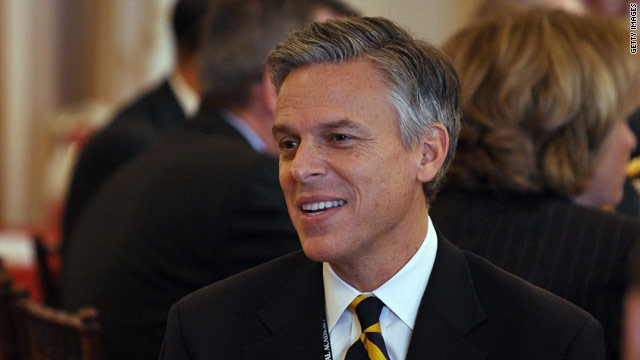
John Hunstman In For 2012

After much speculation, Jon Hunstman has announced that he will be forming a political action committee for the 2012 Presidential Election:
Moving swiftly since his return to Washington from Beijing Friday, Huntsman filed paperwork with the Federal Election Committee to begin “H PAC.” In the event he runs, the organization will be the last placeholder before he announces a full-blown campaign.
“This is a paperwork step,” said spokesman Tim Miller. “He’s doing the organizational things required by campaign finance law. When he wants to make an announcement he will make an announcement.” 
The creation of the political action committee is another strong piece of evidence that John Huntsman will run in 2012. He's already starting to portray himself as a young, hip, cool Republican in attempt to win the support of voters under 40: 
Through calculated press leaks—like last week's motorcycle photos and Politico's profile of the ambassador's "rock 'n' roll years"—supporters appear to be laying the foundation for a new, potentially risky Huntsman brand: the only cool Republican candidate.
If this is indeed the strategy, it would hew to the philosophy of John Weaver, a veteran Republican strategist and avid Huntsman supporter who worked on Sen. John McCain’s 2008 campaign before quitting. Weaver speaks often and ominously about a “ticking demographic time bomb” that’s working against the GOP.
"There's a cultural buffer between people over 40 and people under 40," Weaver told me last year. "We are driving young people away from the party."
Huntsman himself has argued in the past that building a Republican candidate who plays well to that under-40 crowd will likely require a decisive departure from some party dogma. The candidate will have to embrace environmental issues, for instance, and tack to the center on gay rights—both areas where Huntsman has demonstrated moderation.
The strategy of making a political candidate look cool and hip isn't new. Bill Clinton and Barak Obama have both used that strategy with successful results. I don't recall any Republican Presidential candidate ever attempting to use this tatic to win the White House. Jon Huntsman's team thinks that this strategy will work:
And when all those "unguarded" details about Huntsman's youth are strung together, a personal narrative emerges that may be familiar to the so-called millennial generation. As a teenager, Huntsman dropped out of high school to focus on playing keyboard in his band, Wizard. He and his friends split time between practicing in a converted radio station in Salt Lake City, riding around in a Scooby Doo van, and dining at a grubby local restaurant called Bill and Neda's.
Such youthful aimlessness has become a defining characteristic of the modern twentysomething wandering through the American recession. And while Huntsman eventually completed high school and graduated from the University of Pennsylvania, his story stands in stark contrast with the well-bred, ambitious youth of Republicans like Romney.
The strategy may work or it may not work. While he's working to get the youth vote, the older voters may not be excited about him. For example,  he was a Republican who worked for the Obama Administration as an ambassador to China and wrote letters of adoration to his boss:
August 16, 2009
Dear Mr. President,
I am most grateful for the graciousness and kindness you have shown me and my family – particularly your confidence in my ability to represent you in China. Mary Kaye and I will begin our journey tomorrow – leaving behind a state we love – but also anticipating an extraordinary experience in Beijing. You are a remarkable leader – and it has been a great honor getting to know you.
Jon
While some people think his work with the Obama Adminstration will hurt him, others think it will help him: 
In a way and by an irony, in fact, the Obama administration may have done the ambassador a huge favor. Far from sidelining him, his China posting has given him the sort of foreign-policy credentials about which every governor who wants to be president fantasizes on a daily basis. The administration has put him on the front lines of what is arguably the most important economic and national-security challenge that the country faces and, in the process, put him in direct touch with the CEOs of some of the biggest and most powerful companies in the country—all of whom make it a point to meet with Huntsman when they are in Beijing, and many of whom are said to have come away deeply impressed. And in a moment in America when anxiety over the long-term threat that China poses to our prosperity is running high, Huntsman is ideally positioned to capitalize on that emotion politically by presenting himself as the man who understands the nature of the challenge and what to do about it best.
Even if Jon Hunstman can overcome the complaints from the older voters that he has worked for Obama, there are other reasons why older conservatives may not like him is because he's very liberal on many issues such as gay marriage, cap and trade and the environment.
Despite these facts, it appears that the Huntsman is ready to go full steam ahead if the former governor of Utah decides to run.
Another challenge for the former govenor of Utah is Mitt Romney. Although they are both Mormon, they appear to be rivals ever since the 2002 Winter Olympics in Utah:
It first flared when Romney was tapped to take over the 2002 Salt Lake City Olympics — a position that Huntsman's father, a powerful chemical magnate, was pushing for his son. It surfaced again before the 2008 presidential race, when Huntsman abandoned his support for Romney to campaign for rival John McCain.
The fact that John Huntsman and Mitt Romney are both members of the LDS Church will come up as  an issue in the election. However, both men have different approaches in how they plan to explain their faith to the American voter.
"There are just some people for whom it will not be settled," Romney recently told the Boston Globe. "That's just the nature of who we are as a people. A lot of people have differing views."
Huntsman, seen as a less-likely candidate after his appointment by Democratic President Barack Obama last year, appears to be taking a different tack.
In a recent Fortune magazine interview that appeared on CNNMoney.com, his Mormon credentials were described as "soft," unlike his more devout family. His father, Jon Huntsman Sr., is an Area Seventy in the LDS Church.
The former governor noted in the interview that his children attend Catholic schools, and his adopted daughters come from different religious cultures, one Buddhist, the other Hindu.
"I can't say I am overly religious," Huntsman is quoted as saying in the interview, which refers to his consideration of a 2012 run. "I get satisfaction from many different types of religions and philosophies."
One final challenge for Jon Huntsman will be that he will have a hard time raising money for his campaign since he doesn't have enough cash on his own to finance the race and any big name donors have probably made their financial commitments to other candidates.

Monday, May 2, 2011

Everything You Wanted To Know About How The U.S. Took Down Osama Bin Laden

With a major event like America's successful operation on killing Osama Bin Laden, its hard to keep up with all the details that are swirling around. 
I've decided to scour the Internet and compile all the news into one place. This article is rich with links so that you can click on an aspect of the story that you would like to learn more about. 
As time goes on, I will update this article with more information. 
But let us begin with the question most people are asking: how did the United States find Osama Bin Laden?
The tip came from a Gitmo detainee:
It started with an unnamed courier.
Senior White House officials said Monday that the trail that led to Osama bin Laden began before 9/11, before the terror attacks that brought bin Laden to prominence. The trail warmed up last fall, when U.S. intelligence discovered an elaborate compound in Pakistan.
"From the time that we first recognized bin Laden as a threat, the U.S. gathered information on people in bin Laden's circle, including his personal couriers," a senior official in the Obama administration said in a background briefing from the White House.
After the terror attacks of Sept. 11, 2001, "detainees gave us information on couriers. One courier in particular had our constant attention. Detainees gave us his nom de guerre, his pseudonym, and also identified this man as one of the few couriers trusted by bin Laden."
In 2007, the U.S. learned the man's name.
In 2009, "we identified areas in Pakistan where the courier and his brother operated. They were very careful, reinforcing belief we were on the right track."
It appears that the man who gave up the courier's code name was a top al-Qaeda agent known as Abu Faraj al-Libbi, who was bin Laden’s “official represenative to others within the organization. Abu Faraj al-Libbi was captured by Pakistan on May 2, 2005.

The name of this unnamed courier, who went by the alias Arshad Khan or Abu Ahmed al-Kuwaiti, came as a result of the controversial enhanced interrogation techniques of al Libbi and Khalid Sheikh Mohammed and other terrorists. Some of it may have also come from listening in on a terrorist's phone conversation.  

Sometime around August 2010, the courier made his way to a compound in  Pakistani town called Abbottabad, where al-Libi had once lived. The CIA followed the courier until he led them back to Osama's compound. The CIA rented a house near the compound and began to collect intelligence about who was living in that secret mansion: 
The C.I.A. surveillance team in the rented house near Bin Laden’s hide-out took pains to avoid detection not only by the suspected Qaeda operatives they were watching but by Pakistani intelligence and the local police.
Observing from behind mirrored glass, C.I.A. officers used cameras with telephoto lenses and infrared imaging equipment to study the compound, and they used sensitive eavesdropping equipment to try to pick up voices from inside the house and to intercept cellphone calls. A satellite used radar to search for possible escape tunnels.
Still, the spying operation had its limits: the American surveillance team would see a man take regular walks through the compound’s courtyard — they called him “the pacer” — but they were never able to confirm the man was Bin Laden.
After months of observing the compound, the CIA presented the information to Obama and presented the President with some options on how to take down Bin Laden. Apparently President Obama was indecisive on whether or not the U.S. should take out Osama Bin Laden since they were not completely sure he was living there. As a result, the original idea was to bomb the compound but the President nixed that idea because there would have been no actual proof of Osama Bin Laden's death. 
Instead, they decided that they would send special forces in. There was only one objective in this mission: Kill Bin Laden. 
The Special forces trained for months in a mock set up of the compound  that Osama Bin Laden lived in before they actually flew out to do the mission. You can see where the compound is located on Google Maps. Here’s a Google satellite photo of what may or may not be Osama Bin Laden's compound. You can also see some videos of the compound here.
Despite the fact that they were unsure if Osama Bin Laden was in the compound, they decided go ahead with the raid. 
Special forces descended onto the mansion and began the assault. There are reports that during the raid, Osama Bin Laden was asked to asked to surrender before he was taken down. 
Whether the request was made or not, Osama Bin Laden wasn't going to go down without a fight. Special forces went in and killed the world's most wanted terrorist. However, the special forces operators were unsure that Osama Bin Laden was one of the men they killed until they recovered his body.
The raid on the compound was a complete success. Not only did they kill Bin Laden, but they found a gold mine of information for intelligence analysts to look over. This is the list of items that were taken from the compound:
The haul includes 10 hard drives, five computers and more than 100 storage devices, such as disks, DVDs and thumb drives, a senior U.S. official told CNN. The materials might provide clues on al Qaeda members and potential plots for future attacks.
The commandos also recovered five cell phones, audio and video equipment, "lots" of paper documents and some five guns, including AK-47s and pistols, a U.S. official told CNN homeland security correspondent Jeanne Meserve.
That wasn't the only thing that the U.S. special forces took from the compound. There is also an interesting report that people were captured during the raid:
"After bursts of fire over 40 minutes, 22 people were killed or captured. One of the dead was Osama bin Laden, done in by a double tap -- boom, boom -- to the left side of his face."
Could it be that one of the people captured in the raid was Osama Bin Laden's wife? There is a press report stating that she was shot in the leg during the raid. Others think it was one of Bin Laden's sons that was taken:
There were conflicting reports about the second person the US forces took along with them. Some Pakistani officials say it was one of Bin Laden’s sons injured by the US commandos and thrown onto a separate military chopper; others say he was killed in the operation and it was only his dead body that they took along. 


It is confirmed that one of bin Laden's son is missing from the compound.

There are conflicting reports that Osama was killed by one shot to the head, one shot to the face and chest and that he was shot twice to the left side of his face under his left eye.  Either way, the U.S. had  gotten their man. Once they killed Osama Bin Laden, DNA test confirmed that it was indeed the man they were looking for. Osama Bin Laden's body was taken on to the aircraft carrier Carl Vinson and was buried in the ocean.
Right now, there is a debate in the White House on whether or not they will release a photo of Osama's death. However, at some point, it will be likely that a photo of his death will be shown to the world to verify that America really did kill this man since a small number of people are starting to be skeptical of whether or not Osama Bin Laden was really killed. Leon Panetta, the Director of the CIA, says that he thinks the photos will be released soon. Moreover, there's a possibility that the helmet cams of the special forces team that went in to take out Bin Laden will be released to the public.
When I first heard that special forces had killed the world's most wanted man, I initially thought it was either Delta Force or Task Force 121. Nope. It was none other than Seal Team 6 that had the honor of taking out Osama Bin Laden. To learn more about Seal Team Six, I highly recommend reading Rouge Warrior by Richard Marcinko. I also recommend reading this article about how lethal our special forces units have become in locating enemies who do not want to be found by the United States.
An interesting fact about the raid is that there are conflicting reports about whether or not Pakistan was aware or informed about the mission. For example, there are reports that Pakistani Intelligence was on site during the mission:
CNN's Nick Paton Walsh reports, citing a senior Pakistani intelligence official, that members of Pakistan's intelligence service - the ISI - were on site in Abbotabad, Pakistan, during the operation that killed Osama bin Laden.
Yet, that news contradicted by the fact that the Pakistan was kept in the dark about the mission:
But for its own geopolitical—and purely political—reasons Pakistan is likely to continue being as much part of the problem as part of the solution. At least after the Abbottabad shootout, it’s clear the administration isn’t kidding itself. When it got a shot at Bin Laden, it took it. No dithering. No dilatory diplomacy. Secrecy was maintained. The Pakistanis were cut out. And justice was done.
However, it appears that the Pakistanis were cut out of the mission since a senior White House administration official confirmed that Pakistani leaders weren’t briefed until after the attack. And there is good reason why the U.S. didn't tell Pakistan about the raid: Pakistan couldn't be trusted with the information.  Bin Laden was found to have money and some phone numbers sown into his clothing which indicates he was ready to escape at a moment's notice. Perhaps he was prepared in case someone tipped him off that the U.S. was coming for him.
The relationship between Pakistan and the U.S. will be now tense since there are questions of whether or not Pakistan was providing assistance in hiding Osama Bin Laden. Pakistan's President, President Asif Ali Zardari, denies these allegations. However, I think the evidence strongly points to the fact that Pakistan was helping Osama Bin Laden. For example, we now know that a senior Pakistani Army major lived next door to Osama Bin Laden. We also are learning that the local neighborhood children were known to play  inside the compound yard.  Moreover, it appears that the compound was specifically built for Osama Bin Laden in 2005.  Some people think he may have been living in that compound in Abbotabad for as long as three years or as short as six months. According to bin Laden's wife, she was in that house since 2006.
Moreover, there are reports that Pakistan had information that would have led America to Bin Laden but didn't share it with us.
We're also learning that the many people in the U.S. intelligence community not only believe that Pakistan was helping Bin Laden but that Bin Laden's terrorists may have penetrated Pakistan's Inter-Services Intelligence (ISI) and military for years and came very close to obtaining nuclear weapons. 
Another interesting question about Pakistan is why didn't they move Osama Bin Laden after another terrorist was picked up three months earlier in Abbottabad?
WSJ reporter Tom Wright notes an amazing coincidence: Arch-terrorist and longtime Bin Laden crony Umar Patek was also captured in Abbottabad three months ago. Here’s a Jakarta Post story on the arrest published just two weeks ago. (Patek is Indonesian and was linked to the Bali bombings in 2002.) Pakistani intel is now claiming, per Wright, that they helped lead the U.S. to Bin Laden via information gleaned from Patek. That seems unlikely — apparently, we’ve known Bin Laden was in Abbottabad for six months or so, and if Pakistan was providing intel on OBL, Obama wouldn’t have waited until after today’s operation to phone Zardari. Still, it’s too startling a coincidence to actually be a coincidence. Did Patek lead us right to Bin Laden’s door by rendezvousing with him? And why didn’t Bin Laden run once Patek was picked up? He must have known by then that either Pakistan or the U.S. was interested in arresting local super-terrorists.
Were the Pakistanis over confident that the U.S. would never come back to Abbottabad to look for Osama Bin Laden? Did they promise Bin Laden that the Americans would not come back and that there was no point in moving him to a new hideout? 

Now that Osama Bin Laden is dead, Ayman al-Zawahri becomes the top candidate for the world's top terror job. Guess who do you think the U.S. will be looking for now:
The JSOC team captured intelligence materials from the compound that might reveal the location of Ayman al-Zawahiri, the organization’s new commander. “That’s where we’re going next,” says one U.S. official involved in planning the operation.
Update: Apparently, the White House is backtracking on some details of about what happened on the raid of Osama's compound and that the new details conflict with one another:
Officials also retreated from claims that one of bin Laden’s wives was killed in the raid and that bin Laden was using her as a human shield before she was shot by U.S. forces.
At a televised White House briefing Monday afternoon, Deputy National Security Adviser John Brennan said bin Laden joined in the fight that several residents of the Abbottabad, Pakistan, compound put up against the Navy SEALs during the 40-minute operation.
“He [bin Laden] was engaged in a firefight with those that entered the area of the house he was in. And whether or not he got off any rounds, I quite frankly don’t know,” Brennan said.
At a Pentagon briefing earlier in the day, a senior defense official said bin Laden used a woman as a human shield so he could fire shots. “He was firing behind her,” the official said.
In another background briefing early Monday morning, a senior administration official also said bin Laden put up a fight. “He did resist the assault force. And he was killed in a firefight,” the official said.
However, during a background, off-camera briefing for television reporters later Monday, a senior White House official said bin Laden was not armed when he was killed, apparently by the U.S. raid team.
Another White House official familiar with the TV briefing confirmed the change to POLITICO, adding, “I’m not aware of him having a weapon.”
Apparently the White House still can't get its story straight on whether or not Osama Bin Laden was armed during the raid.  White House Press Secretary Jay Carney said that he was unarmed when he was shot yet revised his statement to say that Osama Bin Laden resisted being taken. 
While the White House is busy trying to get its story straight, one of the children who survived the assault on the compound claims that Bin Laden was actually captured alive but shot in the front of the family.
Update: It turns out that the photos of Bin Laden will not be released to the public and the President assures the American people that they are absolutely positive they got him:
“We discussed this internally,” he said. “Keep in mind, we are absolutely certain that this was him. We’ve done DNA sampling and testing. And so there is no doubt that we killed Osama bin Laden.”
“There is no doubt that Osama bin Laden is dead,” he reiterated. “Certainly there is no doubt among al Qaeda members that he is dead. So we don’t think that a photograph in and of itself is going to make any difference.”
“There are going to be some folks who deny it,” he added. “The fact of the matter is, you will not see bin Laden walking on this earth again.”
Personally, I think the President made the right decision not to release the photos. I don't need to see them and neither does anybody else.
 
Update: There is an intriguing conspiracy theory that Ayman al-Zawahiri may have sold Osama out by intentionally letting the CIA follow the courier to Osama bin Laden since there was an irreconcilable split between bin Laden and al-Zawahiri. Its in interesting theory but is highly highly unlikely that al-Zawahiri would have allowed the U.S. to kill him but would have have had his own followers take him out.